Testament
A browser RPG set in the shadow of a tower that is still being built — where the town’s gossip about what you did is a system, not a flavour line.
Play it: testament.bmux.sh
What it is
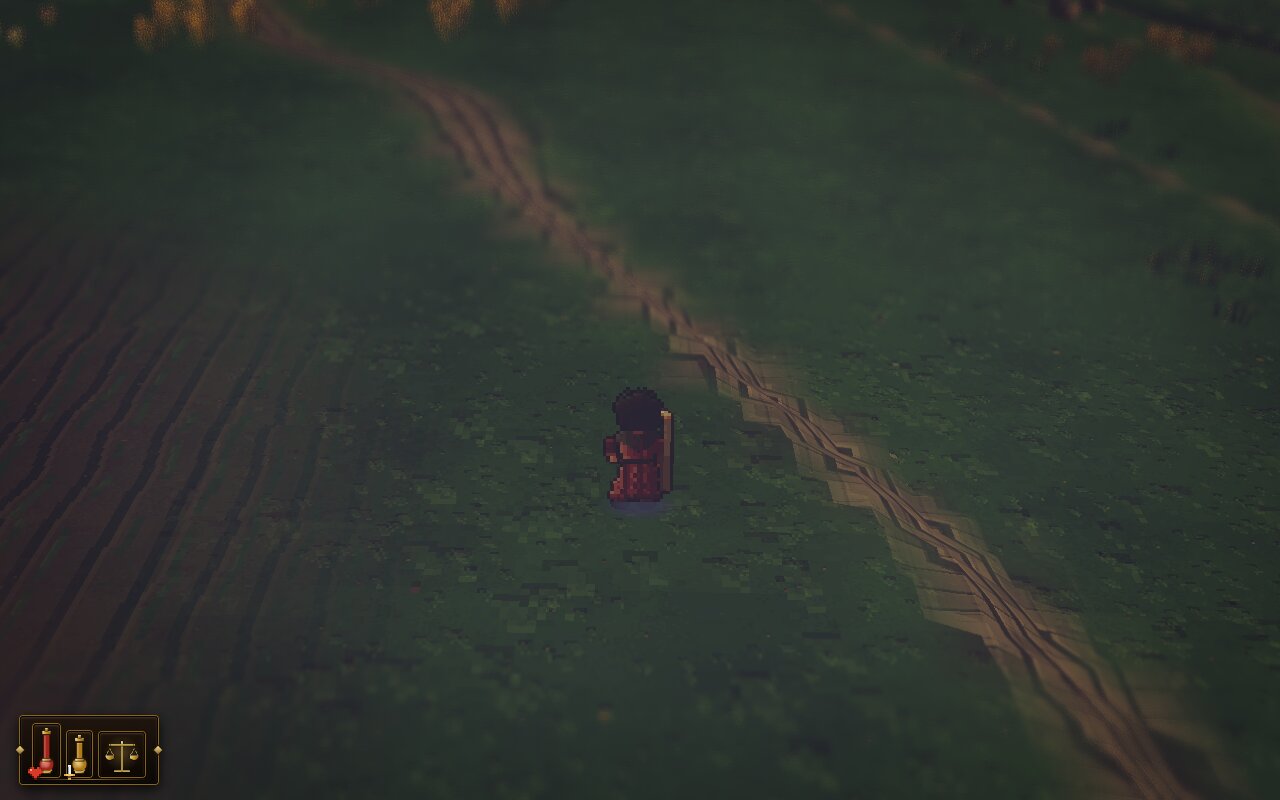
You arrive at a terraced hill city called Zemer, three districts walked on its south face and the rest of it climbing behind them to a crown. There is a works going up nearby, there is a levy taking men and grain to feed it, and there is a raiding season that arrives like weather. The game calls a new run a pilgrimage, which tells you most of what it thinks it is about.
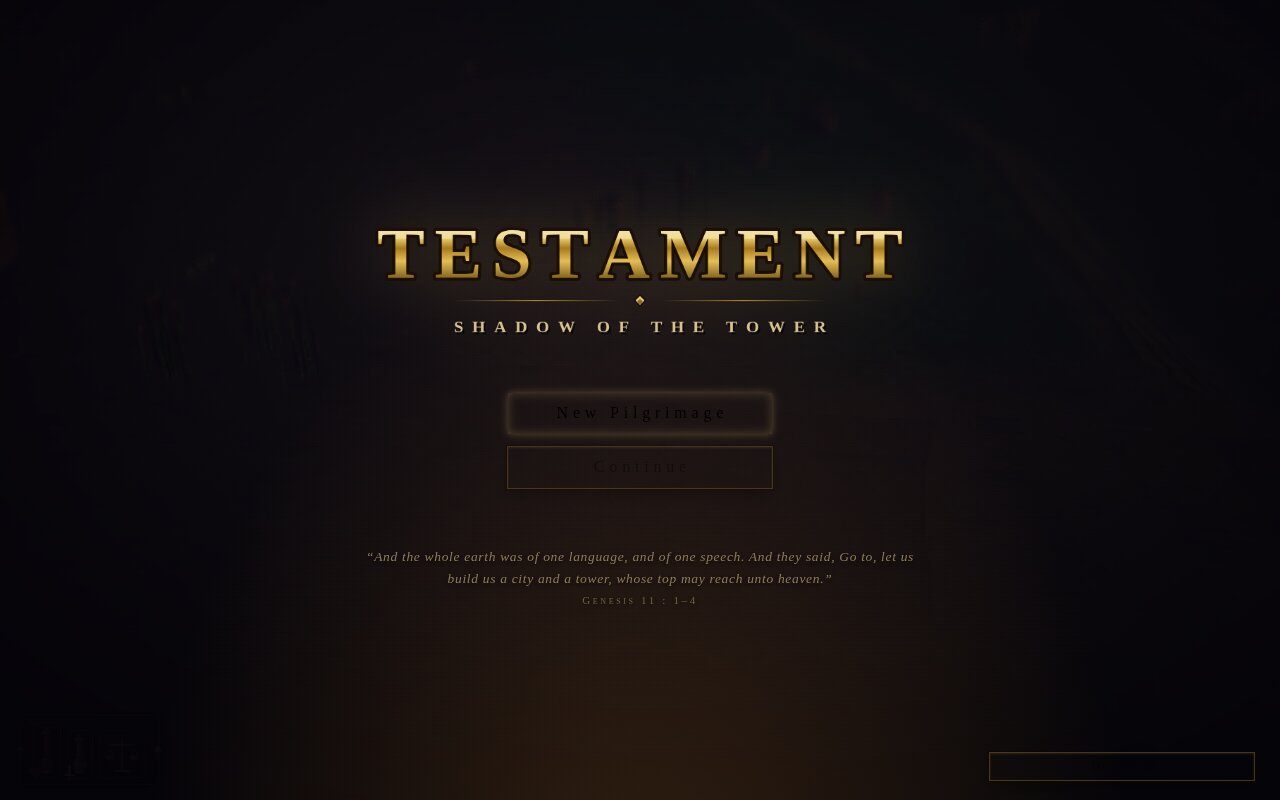
The first cut — v0.1.0, “The Slice Promotion” — turned what had been a combat bench into a playable spine: title screen through to the Scaffold-Foot Gate, three scenes, a full UI, save slots, and four end-to-end probed paths through the whole thing.
The part I’d point at
Most RPGs tell you that your choices matter and then store them in a boolean.
Here, deeds propagate as rumour. Do something at the gate and the road hears a version of it; do something on the road and the gate hears a different one. The retellings mutate as they travel, with their own fidelity falloff, and the rule the system is built to honour is that no two tellings set it in the same spot. The town is not checking a flag. It is repeating a story about you that has already drifted.
The second one is the builders’ covenant, which is a ladder rather than a reputation bar. Fall behind on your tally and you are Short-Tallied; keep falling and you are Called to the Line, and then there is a penance rite, and then renouncement — each rung with its own consequences for your wage and your pass through the gate. It is the most boring-sounding system in the game and the one that most makes the place feel administered.
Then the quests. Two of them are quad-quests — violent, cunning, righteous, or walk away — and the thing that makes them work is that you can resolve them by doing something outside their offer trees entirely. The quest does not have to be accepted to be answered.
The scenes
| The Shinar Road | A milestone run with a drovers’ camp that comes alive at night, a Sharav horn-bearer rally, and rout-and-reform rules for withdrawing |
| The Scaffold-Foot Gate | A shut gate under the works — seal checks, a four-greet breach ladder, a sealed perimeter walked by probe, and a queue that sleeps at night |
| Ash Wadi | A pacify rite on a key-seal plate, a boss arena, and a camp you can withdraw from |
Arrival screens dress themselves to how occupied a place is — wrecked carts, a wayside shrine, porters’ camps, thorn lines. Night canopies take a moon-blue self-fill, and 7:00 after a beat reads as dawn rather than leftover night.
What it cost to make it run
The honest engineering story here is performance, and it is a good one because every guess was wrong until something measured it.
A frame profiler attributing per-pass CPU and GPU time found the street walk was CPU-bound inside the main render pass — 46.8 ms of CPU against 5.1 ms of GPU. The scene graph was the problem: 73,944 objects, 65,458 of them auto-updating their matrices, 29 ms spent in updateMatrixWorld alone. Freezing the matrices took the render from 45 ms to 26. Four fifths of the graph turned out to be fabric and country detail.
Separately, a cold boot spent 215,872 ms building ground. Warming a cache and skipping the fast pass took that to 1,342 ms. Not an optimisation so much as noticing that the thing was being built twice.
Where it stands
488 tests, up from 336 over the slice release. The spine is playable end to end. The acts past it are designed and not built — there is a roster-stripping mechanic called the Winnowing sitting in the documents, and a toolkit of jar-lamps and ram-horns waiting for the act that needs them.
It is the largest thing on this list by a distance, and the one most likely to be mistaken for a tech demo on a thirty-second look, because the systems that make it interesting are the ones you only notice on the second visit to the same gate.